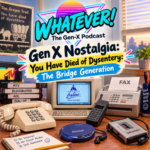
Gen X Nostalgia: You Have Died of Dysentery: The Bridge Generation
Dwayne and Heather pick up the long-corded kitchen phone this week and talk about being the bridge generation, the last kids to grow up before the internet and the first adults who had to figure it out. They look back at the analog life, the clunky early days of getting online, and the gadgets that made them feel like they’d hit the big time. They also dig into which old-school skills still pay off today, what younger folks picked up faster, and what it’s like living in a country that still loves its fax machines. Settle in, and try not to die of dysentery.
All our links: Linktree
Dwayne’s first book on AI: Unlocked: AI For Your Business
Legal
Whatever! The Gen-X Podcast is a production of True North Media. Copyright 2026. All Rights Reserved. Theme music provided by Envato Elements. Used by permission.
00:00:00 Dwayne: Hey everyone. Welcome back to whatever. I’m Dwayne
00:00:04 Heather: And I’m Heather.
00:00:05 Dwayne: And together we’re sharing our Gen X experience. We’d love to invite you along for the ride. Last week we talked about our favorite toys growing up.
00:00:11 Heather: And how some of our parents lost their damn minds trying to find a Cabbage Patch doll.
00:00:16 Dwayne: This week, we’re going to stay in the same vein and dive into early tech and what it’s been like growing up with one foot in the old manual way of living life and one foot in the new, we’re kind of the bridge generation, the last ones who remember life before the internet, and the first ones who had to learn it as adults. But before we get into that, we’d like to remind you to subscribe so you never miss an episode. And if you’d like to support the show, there’s plenty of info on our website. You’ll find links to all that in the show notes. So tell me, how did you die on the Oregon Trail?
00:00:44 Heather: Um, yeah, I probably died of dysentery, as did most people. I don’t think I ever died of a snake bite, though.
00:00:51 Dwayne: Did you ever make it all the way?
00:00:52 Heather: Um, I don’t think so. I don’t think so. But again, this was back when I was, like, in seventh grade or eighth grade when we did this. My memory is not so good anymore.
00:01:04 Dwayne: I don’t know if I, I might need to, like, rip off the corner of my Gen X card or something. I think.
00:01:09 Heather: So. This is ridiculous.
00:01:11 Dwayne: I have never played the Oregon Trail game.
00:01:15 Heather: I saw him playing the game and it was his first time.
00:01:20 Dwayne: Yeah, we.
00:01:20 Heather: Found fifteen minutes ago.
00:01:22 Dwayne: A great emulator on the Visit Oregon dot com website. It’s like the website from the Oregon State Travel Bureau. They’ve got the game uploaded up there. You can go play it for free. Highly recommended. It’s pretty fun, kind of engaging, but I had never played it. The game came out in nineteen eighty five.
00:01:39 Heather: Yeah, I was shocked when you said you had never played it. I thought, come on.
00:01:45 Dwayne: Well, okay. First the original game came out in nineteen seventy one. Yeah, but it came out on the Apple computer in eighty five. And that’s when everyone was getting computers in their schools from Apple. I graduated high school in nineteen eighty five. Didn’t take the computer class. Not because I’m old, but because by nineteen eighty five, I already knew how to program computers.
00:02:09 Heather: Well, it was a mandatory class, and I can’t remember if it was seventh or eighth grade, but it was not an elective class, I don’t believe. But they taught us like the beginnings of programming. I remember making the flowers. You make a flower grow, right? And then playing Oregon Trail in our off time.
00:02:28 Dwayne: It’s a really interesting game. Not just that one. There were games like Zork. It was another text based game. It didn’t even have the fancy graphics that Oregon Trail here has. Oregon Trail is kind of neat that it pops up and you’re crossing the river or going through this town. That was kind of cool. Again, I just got started and I’m going to make it, folks. I will make it.
00:02:48 Heather: I just can’t believe you never played it before. That’s just is shocking to me.
00:02:52 Dwayne: It’s part of, I guess, being an OG.
00:02:54 Heather: I thought all the OGs Had played Oregon Trail.
00:02:57 Dwayne: No, no. If you remember this, this generation goes back to nineteen sixty five.
00:03:02 Heather: I know.
00:03:02 Dwayne: So, you know, some of those people were twenty years old by the time this game came out and was handed out in schools everywhere. But speaking of being a kid, you remember like the analog childhood that we had compared to what our kids ever had and certainly what our grandkids have. You remember just the simple things like telephones and how different it was.
00:03:26 Heather: To rotary dial. You remember we took ten minutes just to make a phone call.
00:03:29 Dwayne: We used to know phone numbers.
00:03:31 Heather: I still know our phone number when I was growing up. I remember, but I don’t remember anybody else’s.
00:03:36 Dwayne: I remember ours from when I was a kid because those were numbers you had to have handy anytime an adult or anything. What’s your parents number?
00:03:44 Heather: I kind of remember my grandma’s, but I definitely remember mine.
00:03:48 Dwayne: And of course, it was must have information when you were out and you picked up the payphone and you hit zero for operator and he said, I need to place a collect call to this number.
00:03:57 Heather: But you know.
00:03:58 Dwayne: Who is this from? Mom. I’m done.
00:04:00 Heather: Yeah, well, yes. Come pick me up. Remember, a lot of places, even the phone booths had phone books in them.
00:04:09 Dwayne: Oh, yeah. Phone.
00:04:09 Heather: Phone books. Actual phone books where everybody’s number was listed.
00:04:13 Dwayne: Everyone in town’s phone number.
00:04:15 Heather: Unless you address.
00:04:16 Dwayne: Unless you paid extra.
00:04:17 Heather: Yes.
00:04:18 Dwayne: To have it removed. It was right there. Yeah. I have trouble today remembering my phone number. I never call me.
00:04:25 Heather: Right. My. So our number growing up is. And I can half way remember my grandma’s but anybody else’s after being a teenager. Yeah. I don’t remember anybody’s phone number anymore. I barely know my phone number. I don’t know your phone number.
00:04:40 Dwayne: No, I’m just.
00:04:40 Heather: Because I just touch your name.
00:04:42 Dwayne: Right there in WhatsApp.
00:04:43 Heather: Which is sad. Our memories are shit now.
00:04:45 Dwayne: Well, our memories are used for other things now. There’s so many other things to remember.
00:04:50 Heather: But phone numbers are a good thing to remember.
00:04:52 Dwayne: Addresses. Addresses are important to remember and we still have those. We still have those. And some of us like I remember a lot of IP addresses, so I got a lot of numbers going on up there.
00:05:02 Heather: Sometimes I remember all of our addresses that we’ve ever lived.
00:05:06 Dwayne: Did you have one of those phones that like hung on the wall?
00:05:09 Heather: Yes, in the kitchen.
00:05:10 Dwayne: Did it have like a ten foot long coiled cable?
00:05:12 Heather: Yeah, like a really long cord. And then it was the rotary dial. So it took like five minutes to actually dial the whole phone number.
00:05:19 Dwayne: I remember my grandmother’s phone. It was rotary dial. It didn’t wasn’t the one that was mounted on the wall. She had the little brown telephone.
00:05:26 Heather: My grandma was black and it sat on the little table.
00:05:29 Dwayne: Uh, grandma’s had there was a little table that was built into the wall right above the phone. Jack. It was a place that the phone gets set. That’s where the phone belonged.
00:05:38 Heather: One of one of our houses that we lived in had a cutout in the wall that went from the kitchen to the dining room. You could access it from both sides, and it was where the phone sat.
00:05:48 Dwayne: My aunt, they built a little small room It was right outside of the bedrooms, between the bedrooms and the living room of their house. And that’s where there was a sitting table. I was just the phone Jack was run to there and that’s where the phone set. There was always a notepad and a pen.
00:06:05 Heather: Many people don’t even know that anymore that they have. They used to have these little chairs with a table.
00:06:11 Dwayne: Yeah, it.
00:06:11 Heather: Was was where you sat to take your phone calls.
00:06:14 Dwayne: That’s what. And you know, and my aunt, she was, she was on a party line for one, remember party lines.
00:06:20 Heather: My grandma was on a party line.
00:06:22 Dwayne: When someone would ring that phone number, it rang everyone on the party line at their house.
00:06:27 Heather: And sometimes you’d pick up the phone and people would be talking.
00:06:30 Dwayne: Yes.
00:06:32 Heather: You’re like listening in on listening in.
00:06:35 Dwayne: Or like in her case, every day at about ten o’clock or so, all the local housewives would pick up the phone and sit there and chat with each other about what was going on on All My Children or the other soap operas. And of course, you know who they saw delivering milk at so and so’s house and leaving a little bit late that day.
00:06:52 Heather: I was a little kid, so I didn’t really understand party lines. I just knew that when I’d pick up the phone at my grandma’s house, people would be talking on it and I’m like, what’s going on?
00:07:02 Dwayne: What’s going on? One of my aunts had the wall phone and it had like a twenty foot long cord. I remember she had three daughters and that phone was never hung up. It was always strung out. Halfway through the house down to the girls.
00:07:15 Heather: Room, there was a coat closet like five feet away from where our phone sat, and I would frequently go into the coat closet and shut the door with the phone, because you used to have to, like, take your phone calls where everybody congregated. So everybody heard your phone conversation.
00:07:29 Dwayne: Everyone heard your phone conversations. When I was older, we had a cordless phone and that was just the best thing ever. We could take the call and you could go outside. It would even work out in the yard. And of course it worked all throughout the house, and that was awesome until you hung up the phone and you just set it down somewhere.
00:07:46 Heather: And then it would die.
00:07:47 Dwayne: And then the phone would ring half an hour later for them. Where’s the phone? Running through the house. Sorry, mom. Sorry.
00:07:56 Heather: When I was a teenager, I had a blue plastic phone that had the buttons on it. I remember talking to friends. Oh, Lord. It’s probably why I don’t like to talk on the phone anymore. Because I would talk for hours. I actually woke up at like two a m once, because I had been talking to a friend and fell asleep on the phone.
00:08:19 Dwayne: Also, from that era, we didn’t just have old analog phones. We had analog everything.
00:08:27 Heather: Everything.
00:08:28 Dwayne: If you had to do a report for school or just wanted to know something, you had to go look it up. You didn’t have Google, you didn’t have ChatGPT. You had to do the research yourself. And it wasn’t easy to find.
00:08:41 Heather: Sometimes you had the library and the Dewey Decimal system.
00:08:44 Dwayne: You had drawers full of cards.
00:08:47 Heather: And you had to know what you were looking for. It wasn’t just like, I need to find something on this subject. You. You needed to know exactly what you were looking for.
00:08:56 Dwayne: You really did. It was a totally, totally different way of research and trying to find things.
00:09:02 Heather: Those cards, there were like thousands and thousands of cards, and you had to write down the the Dewey Decimal system number, and you needed to know how to go find that.
00:09:11 Dwayne: Remember how difficult it was to just navigate places.
00:09:16 Heather: Because you had to have a map book and you had to have a navigator.
00:09:21 Dwayne: Pretty much.
00:09:22 Heather: Because you couldn’t be flipping those pages while you’re driving, or you would have to memorize the roads that you needed to be on and which turns you needed.
00:09:32 Dwayne: Yeah.
00:09:32 Heather: Otherwise, you were getting lost.
00:09:34 Dwayne: I remember the first real road trip that I drove on and navigating from West Virginia to West Texas. The hardest part of the whole thing was coordinating the fact that we were going to meet with a friend at a halfway point.
00:09:48 Heather: Yeah. Like no cell phones.
00:09:50 Dwayne: We didn’t have cell phones. No, not at all.
00:09:52 Heather: Are you going to. No. He was there at the same time that you needed to be there. You know.
00:09:56 Dwayne: We called and we coordinated and we we looked at the maps and the old Rand McNally atlases. They had not just mileage between, but like drive times between major cities. So we figured, okay, by about two o’clock in the afternoon, we should be here. And he’s like, well, I should be there about three or so. Okay, we’ll meet at this exit. It looks like there’s an intersection here to the right, and there’s probably a gas station around there. We’ll meet at one of those.
00:10:21 Heather: And hopefully you all get there.
00:10:22 Dwayne: And hopefully we all got there around. But we did. We all met up there and continued our little convoy out to West Texas.
00:10:28 Heather: You either got lost or you just took really scenic routes and call it that.
00:10:32 Dwayne: I’ve done a lot of both. Yeah, really we have.
00:10:35 Heather: We’ve gotten lost in Texas, not going to lie with a camper.
00:10:39 Dwayne: Even with GPS.
00:10:40 Heather: Yeah, because there.
00:10:41 Dwayne: Are parts of this world where if you don’t have cell phone service at the same time, that GPS is kind of useless because the maps just they’re blank.
00:10:48 Heather: It makes for interesting trips.
00:10:50 Dwayne: Yeah.
00:10:51 Heather: You know.
00:10:52 Dwayne: That’s that’s when we decided it was that little trip right there. We decided, you know what? We need a paper map in here with us in the cab and went and got one just for such a thing.
00:11:01 Heather: Otherwise we would have ended up in a river.
00:11:04 Dwayne: I remember driving.
00:11:05 Heather: Over that road. It ended.
00:11:06 Dwayne: It ended in a river.
00:11:07 Heather: Yeah, it was like washed out.
00:11:08 Dwayne: Washed out bridge. Had to back a camper up, what, probably a quarter of a mile. Yeah. In order to get turned around. That’s a camper trailer, folks. Not a not a single drivable thing. Oh, no, I don’t do anything that easy.
00:11:20 Heather: That’s not fun that way.
00:11:26 Dwayne: For years, we’ve had music at our fingertips. People have Spotify or YouTube music or whatever you got. Just type in an artist. You get recommendations for other folks who are kind of like that. Back in the day, we had deejays at local radio stations.
00:11:39 Heather: Good deejays.
00:11:40 Dwayne: Who decided, I won’t say the local DJ decided what got played. Um, that was more their bosses. The station managers decided what got played, but we had them sending out the music to us, and we would sit there with a cassette player and try to catch hear the first note of a song, try.
00:11:54 Heather: To.
00:11:55 Dwayne: Hit.
00:11:55 Heather: Those buttons right at the same time.
00:11:57 Dwayne: Gotta hit those two record and play buttons there simultaneously to get that tape rolling.
00:12:00 Heather: You got real good at it. Or real frustrated, real frustrated.
00:12:04 Dwayne: And if the DJ went talking over the song, that was the intro. Oh that’s annoying, I hated that.
00:12:10 Heather: I got really good at.
00:12:10 Dwayne: It. Oh yeah, me too.
00:12:11 Heather: I mean.
00:12:12 Dwayne: Tons, tons of, uh.
00:12:13 Heather: I feel like if cassettes, if you were in the eighties, you were probably really good at it.
00:12:18 Dwayne: That’s why most of us can tell, like so many of those songs from the eighties, by the first note.
00:12:22 Heather: First note? Yeah. What did boredom feel like for you?
00:12:28 Dwayne: I was always one of those people, and I’ve always been one who can keep myself entertained. So I’m really it’s really difficult to bore me, though. One thing that I always felt was boring, especially before I was driving, was riding in a car and we would take road trips anywhere.
00:12:43 Heather: I always enjoyed road trips, but well, we had. I enjoyed looking around at the landscape and cow.
00:12:49 Dwayne: Yeah, yeah, exactly. That’s why I always talk to him when we drive past moo cows and sheep, either one I, I was always looking out for those or horses. Oh, I, I see a horse today. I’ve got to announce it. Horses. Sorry. That’s just, it’s ingrained from my childhood because there wasn’t much else to do in the car, especially when it was just me and mom. She was concentrating on driving, and I was doing my best to sit over there and not distract her and, you know, cause an.
00:13:13 Heather: Accident to my mom’s, like, Oak Ridge boys or Anne Marie’s tapes.
00:13:17 Dwayne: I’m sorry. At least my mom had decent musical taste.
00:13:20 Heather: I mean, Anne Marie, I went through a phase where I really liked Anne Marie, so it was okay.
00:13:28 Dwayne: We talked a little bit earlier about the school computer lab. Do you remember when the school got a computer lab or did they already have one when you went through?
00:13:35 Heather: Um they weren’t, I don’t think they were new when I went in, it was relatively new. It was when I was in seventh or eighth grade. I think we may even had them in sixth grade, but they weren’t like real widely used. And it was just like, you know, text based stuff. I just really remember the class in seventh or eighth grade, learning to code, making pictures.
00:13:56 Dwayne: I remember we had a computer lab actually got stood up for my senior year in high school. We had representatives from Apple come in and show everyone and like a big school assembly. During my junior year, during that time, they came in and they gave this assembly. They showed these are the computers were going to bring in. These are the kind of things you’re going to be taught, blah, blah, blah. And so then for my senior year, that was already set up that.
00:14:21 Heather: When I was in high school, I remember taking a typing class, but it was still on typewriters.
00:14:25 Dwayne: On typewriters. I never did take one of those. I learned to type the hard way, and I still don’t type with all my fingers.
00:14:31 Heather: Maybe it was on a computer I don’t remember, but I took I took typing class. Yeah, I can type with I can type Great.
00:14:42 Dwayne: I remember the first time I got online, it was, oh gosh, about nineteen ninety three or so.
00:14:50 Heather: When I was graduating high school, y’all.
00:14:53 Dwayne: Well, I was, I was in the Army, and I had a twenty-four-hour duty one night. And myself and this young lieutenant, he had brought in his computer, and he had this thing called CompuServe on it. He could dial up to CompuServe, and CompuServe had an app on it that you would connect you to the internet. The internet at that time was all text-based. I don’t even think that we. We didn’t visit a website at all. We. Everything was text-based. I remember going to the Library of Congress website and viewing stuff, and we did this little thing that night. It took us all night. We went from his PC, we logged into a computer in France. And then from that computer in France, we logged into one in Great Britain and we worked our way around the globe that night, just looking for computers that we could even log into. And what’s the password to get into this? Back in those days, for most everything, the username was user and the password was blank. You just hit enter and ta-da! You were in it, and you could see what was there. If there were any documents that they had shared with anyone, and then how you could see what computers it could connect to.
00:15:56 Heather: See, I never learned any of that kind of stuff. I think the first time I was on the internet was probably at a library with Ask Jeeves.
00:16:04 Dwayne: Yeah. When the web came along. Yeah, that’s when I knew. Whoa. Okay, now this is done. Got real.
00:16:10 Heather: This is when the web came along. I was just like, I really wasn’t. Honestly, I really wasn’t that interested in it. I was, like, clinging to my old ways. The ways of the old gods.
00:16:25 Dwayne: Did you ever have AOL?
00:16:29 Heather: I never had an AOL account. No.
00:16:32 Dwayne: For those who don’t know, AOL was America Online.
00:16:35 Heather: Yeah. I never had an I never had an AOL account.
00:16:38 Dwayne: They were super heavily marketed by attaching first floppy disks and then later CDs to magazines. And they would just or just deliver them to people’s mailboxes. But drop this thing in your computer, it’ll install a little program. Yeah. That’s how they did their marketing. That was it. This was before you could just go online and download something you needed to get online to begin with, folks. Of course
00:17:04 Heather: You’ve Got Mail.
00:17:05 Dwayne: The movie, you’ve got mail. They use AOL as the screens on everything in that thing. Distinctive sound that it made when you got it. I never had an AOL account.
00:17:13 Heather: I had Hotmail.
00:17:14 Dwayne: I had CompuServe; that was my first internet service provider as well. They had kind of moved more to being an ISP than a separate service like.
00:17:23 Heather: AOL heard the name. But yeah, I had Hotmail and. But now I don’t ask me what the username was. I don’t even remember.
00:17:30 Dwayne: AOL and CompuServe both. They were both a computer system that you could log into, and on that system there were thousands and thousands of users that were there. There were user groups, different interest groups. You could download files and stuff. Okay. It was kind of like a Reddit or. Yeah. Or discord.
00:17:48 Heather: Yeah.
00:17:49 Dwayne: Combination.
00:17:50 Heather: Do I know what you’re talking about now? I just didn’t know that’s what it was called.
00:17:54 Dwayne: Yeah. On just down onto AOL, you could like click a news button and you would get.
00:17:58 Heather: I do remember.
00:17:59 Dwayne: That various sources there. You could select your sources and such. Now all these things are done on the web, but at that time it was very innovative. It was brand new and it worked on slow dial up modems.
00:18:09 Heather: Oh, God, the dial up modems dial up. And you couldn’t use the telephone if somebody was on the computer. Get off the computer. I need to use the phone.
00:18:22 Dwayne: What about pagers? Did you ever have a pager?
00:18:24 Heather: The only time I ever had a pager was, like, at work, which would would have been in, you know, nursing home or hospital use. So it’s not like I had my own pager, right?
00:18:33 Dwayne: No, I never had a pager. I got my first cell phone in nineteen ninety five. It was a company provided phone. Actually, it was a car phone. It was a cellular phone that had a fancy mount in the car. And they had to hardwire it. You know, they paid.
00:18:48 Heather: So cool.
00:18:49 Dwayne: They paid this company to wire it into the stereo system, and they mounted a little microphone in the steering wheel, like on the top of the steering column. It was so cool. I thought, oh, I have, I have hit the big time now.
00:19:01 Heather: I thought I was cool in two thousand and two with my track phone.
00:19:07 Dwayne: Well, my cell phone that I had used it for business purposes only. It was for work only because every call was logged and watched at and everything. So. And I don’t call people anyway. I called for for work purposes. I’m coming out to fix this. Or people could call me, I need you to come fix this.
00:19:22 Heather: I remember the old blackberries.
00:19:24 Dwayne: I hated the blackberries.
00:19:25 Heather: I, I saw yours and I just I wanted a blackberry so bad.
00:19:30 Dwayne: I hated the blackberries. I really did, because they were literally the company leash. They really were. So I worked for the government at that time. They gave you a BlackBerry? Well, that meant they expected you to be reachable twenty four over seven. Wow. And you, you were getting your email on that thing. You were getting the calls and everything and it sucked.
00:19:47 Heather: I mean, I worked in healthcare and I had my personal cell phone and I had a work cell phone.
00:19:54 Dwayne: Oh, yeah. Well, I went through years of that as well. Then when we got rid of the blackberries, then you remember for the longest time, I only carried the company phone. I didn’t even have my own phone number. I refused to carry around two phones. If they’re giving me one, I’ll use this stupid thing.
00:20:06 Heather: I could have done that at work too, but I was like, no, I prefer keeping that separate.
00:20:12 Dwayne: Well, it’s not like I installed a bunch of apps or anything. You couldn’t own the company?
00:20:16 Heather: No. Yeah. Our phones. You couldn’t install anything.
00:20:19 Dwayne: Honestly, for once in my life, I was kind of a Luddite about technology. I was not an early adopter of the smartphones because they were so expensive.
00:20:27 Heather: Yeah, they were ridiculous expense.
00:20:29 Dwayne: We had a house full of people and didn’t have a really high salary, and I was like, I can do without that. Especially at that time when everyone needed a cell phone or definitely wanted one. So we get what we could. We got dumb phones, had them for the longest time. I mean, you got an iPhone long before I did. Yeah, about three or four years before I had one, I had a BlackBerry.
00:20:48 Heather: Yeah. You had the BlackBerry. And I was so jealous of that. I did get a BlackBerry. I remember though. I remember that little red one. And now I think back to those blackberries. And they were so small.
00:20:57 Dwayne: The only thing they were good for was email.
00:20:59 Heather: Yeah.
00:21:04 Dwayne: With all this tech stuff, what was the moment you realized the world had changed for you?
00:21:09 Heather: Um, probably seeing it in the banks that I’m using the computers in the banks, when you would go into the bank and they’d be doing everything on the computers. I was not an early adopter of being online. I was like, nah, I’m good. I went to the community college and I took some classes on computers because I knew they. Were you were going to eventually have to know this stuff? Yeah. And I took some classes. But as for my own house, I didn’t have. Computer, I didn’t have a cell phone. I had a landline. Yeah. Two thousand, two thousand and two.
00:21:44 Dwayne: I would say I, I really realized that things had changed. The first time that I had someone show me the World Wide Web.
00:21:51 Heather: Oh, yeah. When I had the web.
00:21:53 Dwayne: When I first saw that, I was like, oh. My gosh, this is, this is kind of revolutionary.
00:21:58 Heather: Because I saw that stuff, but I was like.
00:22:00 Dwayne: I had done the internet and the internet was all text based before that. And there wasn’t a lot. But when he first showed me the World Wide Web and I’m like, I, I have to have this. And the guy literally, you know, copied off the, the programs that I would need onto a floppy disk for me to take home so that I would be able to set up my modem to do dial up and launch it had to launch the right little thing before you ever launched mosaic, the web browser. Yeah. Long before there was Internet Explorer or anything, or even Netscape, I was on mosaic. But things were graphical now, and you could link to other things and just able to connect to anything, anywhere. And within a year or so, I started seeing stores pop up online. And when I saw news and stores coming up online, oh, things have changed greatly. I was overseas at the time still, and I remember a company called CD. Now, as for those who listen regularly, you’ve probably figured out now I’m a music buff and with CD now, I could order CDs of basically any genre or stuff from back catalogs that you could never find anymore, or certainly couldn’t find overseas, and have them sent to my local address through the mail. That was amazing. That company since been bought out by Amazon, who’s pretty much bought everything.
00:23:17 Heather: Everything.
00:23:18 Dwayne: But yeah, I was there for that. I was there for the big dot com era of ninety eight, ninety nine.
00:23:23 Heather: Yeah, that was the time when I was like actively avoiding the internet. I was like, no, I don’t want any part of this. I like my life the way it is. I don’t want to be on the web.
00:23:34 Dwayne: And Get Off My Lawn.
00:23:35 Heather: Get off my lawn.
00:23:36 Dwayne: And you were what, twenty six, twenty seven at that time? No, twenty five.
00:23:40 Heather: I mean, ninety five. I was like twenty twenty. Yeah, yeah, I was twenty so I didn’t want anything to do with doing it. I thought it was stupid. I didn’t want to learn it. I mean, I worked in a nursing home until like two thousand. And at that point in two thousand, we were still doing paper charting.
00:24:01 Dwayne: So what do you feel are maybe skills that we have as Gen Xers that younger folks don’t.
00:24:07 Heather: The ability to, to find answers that are, you know, that you have to dig or like everything’s like readily available right now. Back then, it wasn’t you had to know what you were looking for or how to find it or where to find it.
00:24:21 Dwayne: And that gives you a leg up in using today’s sources.
00:24:25 Heather: Yeah, because even today, kids don’t know how to do the simple search on the internet.
00:24:30 Dwayne: Well, when you go searching for things today, especially if you’re using something like Google or Bing, either one, the first results that you get are sponsored links from people that are paying you to push this out there. And then the next ones you’re going to get are Google likes to source Reddit a lot. So you’ve got a lot of people’s opinions and things that are coming in there.
00:24:48 Heather: Now you got to know what is actual fact. You know, what’s fact, what’s opinion? You got to be able to.
00:24:54 Dwayne: And the way the internet has evolved as well, a lot of the facts are stored behind paywalls. You got to pay to get to any decent journalism or anything too. So it’s getting to be very difficult.
00:25:04 Heather: Very annoying when I want to read something educational or scientific or.
00:25:11 Dwayne: Oh, those are all behind paywalls.
00:25:12 Heather: Now everything is behind paywalls, I hate that.
00:25:16 Dwayne: Yeah. When I was going through college twenty fourteen to twenty sixteen, everything was done online there. The research library that we had access to was just amazing. And I thought, wow, we if the general public had access to this kind of stuff. And so you go look into what does it take to subscribe to this? Well, as an individual, you pretty much can’t. You’ve got to be an institution to be able to afford the subscriptions, to even get at this information anymore. And that’s sad. Sure, you can go to your library and they’ve got some of these search engines, but the search, all you get from that is like the name of the paper, just an abstract. You don’t get to actually go in and read the paper. And that is, I think.
00:25:55 Heather: Honestly, a lot of people aren’t going to take the necessary time to, to find that whole article. You can find them, but you kind of know how to find them. There’s still things online that today, people they never find because they don’t know how to search. Even today, in twenty twenty six, people can’t figure out how to search.
00:26:14 Dwayne: Not just online. Simple things like reading a map.
00:26:17 Heather: Oh yeah, reading a map is like. I mean, that’s a skill.
00:26:20 Dwayne: It absolutely is. I mean, figuring out where you’re at on a map. Yeah. Figuring out where you want to go on a map. There are basic skills that humans have had for hundreds and hundreds of years since they were navigating the stars.
00:26:32 Heather: You know, and they read a map.
00:26:33 Dwayne: Point out where we’re at, right?
00:26:35 Heather: What do these symbols mean on this legend?
00:26:37 Dwayne: How do we get from here to there?
00:26:39 Heather: Simple things like that. I’m a great map navigator. I mean, I have navigated us.
00:26:44 Dwayne: You have navigated us. You’ve done great on on the roads and everything. And. Can you think of any skills that the younger folks have that they’ve got, uh, through their upbringing and the time that they’ve come up that, that we’ve had to scramble to learn? Um, I think things like social media, most of them grabbed on to a lot of social media sites. Yeah. Things a lot faster than we did.
00:27:09 Heather: Yeah. I still to this day.
00:27:11 Dwayne: Back when social media was worth going on.
00:27:12 Heather: Yeah. I mean, even now, today, some of the social media, I’m like, what is the point of this.
00:27:18 Dwayne: Well, for our listeners, it’s a great way to find out when we publish new episodes.
00:27:23 Heather: Yes.
00:27:23 Dwayne: And, and keep up with, you know, little, little short things. We, we like to post little funny things every now and then. So do follow us there. If you happen to find yourself on the socials. And we know that a lot of people like to go out there and just doomscroll at least go get a laugh from us, or at least know when the next episode’s coming out.
00:27:38 Heather: I mean, come on.
00:27:39 Dwayne: But I remember when Facebook used to be a place where you went to find your friends and you talked, you know, kept up with your friends.
00:27:45 Heather: And now it’s just a lot.
00:27:47 Dwayne: It’s, it’s evolved into something totally different.
00:27:49 Heather: To the doom scrolling.
00:27:50 Dwayne: It. It has all of them really have. The younger folks, though, tend to have taken to these things a lot easier.
00:27:57 Heather: Yeah, a lot easier.
00:27:58 Dwayne: I fall into them.
00:27:59 Heather: I think some of us Gen Xers might be like reverting back to analog days for.
00:28:05 Dwayne: Some.
00:28:06 Heather: Things. Yeah, for some.
00:28:07 Dwayne: Just because the way, uh, the intuitive location of everything has happened, we’re just like, okay, you know what? There was a better way to do this. I’m going back to that.
00:28:14 Heather: I do think our generation though, is taking to AI better?
00:28:20 Dwayne: I think so as well.
00:28:21 Heather: I think we’re using it for the purpose it was intended for, and not to just make your fake pictures with.
00:28:28 Dwayne: Yeah, making stupid little movies with and, and coming up with fake pictures and everything for it. I’ve used it extensively. I hell, I just wrote a book. Focus on using AI to run your small business. If you’re interested, go check it out. It’s on Amazon. It’s unlocked AI for your small business. Go check it out. Go buy a copy, leave a rating anyway. But it’s all about, you know, the good use of the AI and not just, you know, playing with it. I hear that a lot of times from the young folks because they were never taught how to really search for things. They’ve also never been really taught how to explain things. And when you’re using an AI.
00:29:05 Heather: You have to know how to explain it. The correct way to get the answer that you need, right?
00:29:10 Dwayne: Because AI is going to come back, it’s going to give you an answer that you want. It’s going to tell you what you want to hear. You legitimately have to tell it. Don’t patronize me. Turn. No confirmation bias. I want the real skinny on this, and then pose your question and make sure that you set boundaries for it. Don’t make this up. I want you to cite three sources for this information. Back up your facts. Back up your information with facts. And if you do those things, you’re very likely going to be successful. But if you don’t do those things well, you end up with, oh, this thing’s a piece of crap.
00:29:42 Heather: Oh yeah. Or the people that are saying AI is dumb and it’s, it’s not good and it can be good. You can use it for good.
00:29:54 Dwayne: Are we the family tech support for our parents and the ones asking our kids how to use an app?
00:30:00 Heather: Yeah, I mean, definitely my mom needs help using.
00:30:04 Dwayne: Oh yeah, we’re the tech support for our parents, but some of us with the tech support for our kids as well. Well.
00:30:10 Heather: Yeah, but I mean, they’re learning.
00:30:13 Dwayne: Yeah.
00:30:14 Heather: For tech support. You know they’re learning it, but like apps. Um, yeah. I’ve asked our kids some stuff about apps before because I’m like, I don’t like TikTok. I, I, I don’t get it. To me, it’s just I don’t get it.
00:30:26 Dwayne: I don’t understand the allure to it.
00:30:28 Heather: I don’t either, I don’t either.
00:30:30 Dwayne: I really don’t. Does knowing life without the internet make it easier for you to put the phone down, or are we just as hooked?
00:30:41 Heather: Um, I think we are hooked on the internet, but at the same time, we have enough in us that we can say, okay, I’m putting my phone down and I’m going to go to my coloring book and I’m going to color because I don’t need this doom scroll anymore. I like to read on my phone a lot, which I know I’m always getting yelled at, not to read on my phone. But yeah, I get tired of just scrolling and being on the internet.
00:31:14 Dwayne: A lot of the time I’m playing like puzzle games and that sort of thing. Just trying to use my mind a little bit more than just having stuff fed at me from a feed somewhere. I do like to do that, and so I will have the phone with me.
00:31:25 Heather: If I get tired of scrolling. You know, I don’t want to play games on my phone again.
00:31:30 Dwayne: Most of the game, most of the games that I’m playing, I can’t play any of the big games. I don’t I don’t enjoy that. I prefer just like, um, word puzzles, that sort of thing. Things that make me think a little bit and yeah, I’ll.
00:31:41 Heather: Just, I’ll read a book or I’ll, you know, I’ve got my coloring books that I enjoy coloring old school kind of like drowns out the noise of everything.
00:31:54 Dwayne: Millennials claim to be the last generation that, uh, you know, had there were analog and went to digital. They saw the tail end of analog.
00:32:04 Heather: Barely.
00:32:04 Dwayne: Barely. They saw it as children. We saw it as adults. I was an adult when the internet became a thing. I had done years of navigating the hard way, shopping the hard way, banking the hard way. Yeah, they saw a little bit of that. But they. I mean, heck, all of our kids had online bank accounts at as teenagers. Yeah. So that I, I don’t credit millennials with actually having that experience nearly as much as I do our generation.
00:32:31 Heather: Right. Yeah. We’ve, we’ve seen the best of both worlds.
00:32:34 Dwayne: Yeah. And Gen Z and Gen A, these kids have never known anything.
00:32:38 Heather: Never known.
00:32:39 Dwayne: Never known a world without the internet, never known a world without being able to have instant access to all the information and disinformation in the world at your fingertips. Most kids today have never had the experience of being unreachable, right?
00:32:54 Heather: Like, there have been times when you go to your friend’s house and your parents are like, where have you been?
00:32:59 Dwayne: Yeah, I know as a kid, and we kind of touched on this last week, there were plenty of times when I would be out playing with the neighbor kids, and we would all just kind of end up at someone else’s house over here. It’s not like anyone called back in and checked with mom. I’m going over to so and so’s house. We just.
00:33:15 Heather: Went. We just.
00:33:16 Dwayne: Were. Yeah. If my parents needed to reach me, it was a series of phone calls.
00:33:21 Heather: Right? Are they there? Are they there?
00:33:23 Dwayne: I cannot tell you the number of times that I came home to check in. And either no one was home because, well, they couldn’t find me, so they went out without me or I would swing by my grandmother’s over there and she would maybe know where they had gone to otherwise. Yeah. Hey, kid, you weren’t here. You missed out.
00:33:39 Heather: Yeah.
00:33:40 Dwayne: I don’t know any kids today who would ever experience that?
00:33:43 Heather: Oh, no. Like all of our kids, even the youngest. So he he had a cell phone early for medical reasons. But all of our kids had cell phones.
00:33:51 Dwayne: Like, well, we we wanted to be able to reach them and, and we wanted them to be able to reach us.
00:33:56 Heather: Why?
00:33:57 Dwayne: Because I do.
00:33:58 Heather: The helicopter generation that began.
00:34:00 Dwayne: Well, not just that. I know that as a kid, when I would come back home and nobody’s there.
00:34:04 Heather: Yeah, you’re like freaking out. Where is everybody?
00:34:06 Dwayne: Yeah, I wasn’t wasn’t freaking out, but like I was FOMO and I felt like I was missing out. What? You know, you went where without me. You went to dairy Queen without me and didn’t bring me anything back. Uh, you know that that happened all the time. And so I didn’t want to put my kids through that because I felt, you know, just like, so left out of a lot of things. Even though I was off traipsing around having fun on my own, it was no fault of anyone’s. It’s just that’s the way things were. And I didn’t want our kids to have to go through all that. I will say the flip side of that is I am very happy that I got to grow up in a time where everything wasn’t documented.
00:34:46 Heather: Yeah, like literally everything is documented these days.
00:34:50 Dwayne: You can’t teenagers do stupid things. That is you. You get a license when you write, when you turn twelve years old, the next five to eight years are going to be very bumpy for you. You’re going to go through some stuff you’re expected to. It’s called growing up. When we were kids. I know I did a lot of stupid stuff.
00:35:09 Heather: We just have a lot of memories.
00:35:11 Dwayne: And I’m to the point now where I can’t remember half of them, but there’s no proof of it. There’s no evidence of it other than if you talk to a friend or someone that was around, remember it. They too are aged and may or may not remember it.
00:35:25 Heather: Yeah, I mean, I took a lot of pictures when I was a teenager, but again, you know, you had to go and get that film developed. It’s not like it was digital and half those photos didn’t come out right because the cameras didn’t focus the right way.
00:35:39 Speaker 5: Mhm.
00:35:39 Heather: Yeah. The cameras have come a long ways, kids.
00:35:41 Dwayne: Fortunately, I did not carry a camera around with me everywhere as a teenager. I’m still, you know, the guy. I carry a cell phone with me everywhere. And I have to remember every now and then. Oh, I should pull out my phone and take a picture of this. That’s really cool. I it’s not my first initial reaction to things.
00:35:58 Heather: And I take pictures of you.
00:35:59 Dwayne: Take pictures of everything, but I’m, I have to remember, oh, that would be cool. Take a picture of it and pull the phone out and launch the camera app. And by that time, the dog has moved.
00:36:07 Heather: And here I am, the one that’s like.
00:36:09 Dwayne: I already got three pictures of.
00:36:10 Heather: It. I’ve gotten to the age where I’m photographing mushrooms.
00:36:14 Dwayne: Now she’s got to that age, folks. What do you think about friendship and dating through a screen versus calling the house and talking to someone’s dad first.
00:36:27 Heather: Or their mom? You know, just their parents in general? Yeah, that that was so nerve wracking. Yeah.
00:36:33 Dwayne: Today the kids can, you know, because everybody’s got their own little, little texty texts going on their, their own. They can text back and forth. They can, you know, when I was a kid, it was passing notes.
00:36:43 Heather: Everybody heard your conversation.
00:36:45 Dwayne: I remember in high school passing notes.
00:36:48 Heather: Yes.
00:36:48 Dwayne: How anyone got anything done in class? It just baffles me because there would be I would be passing notes to friends. Other friends would be passing notes around. It was a constant change. Like, who is this addressed to?
00:37:00 Heather: I think we were able to like, multitask better.
00:37:04 Dwayne: Yeah. True. True. But those notes, oh my gosh. They so many.
00:37:09 Heather: Of them would get, you know, like real deep too.
00:37:12 Dwayne: Oh yeah. Oh, yeah.
00:37:13 Heather: You’d have to ask all sorts of questions, you know.
00:37:15 Dwayne: Oh, yeah. But there was and there were so many chains of them going around and everything. And I remember coming home from school and it’d be like, you know, four or five notes in my pockets and.
00:37:25 Heather: Your backpacks full of notes.
00:37:26 Dwayne: Backpacks full of them. I would have.
00:37:28 Heather: Saved some of those notes.
00:37:30 Dwayne: I’m glad I didn’t. Again, embarrassing, stupid teenage things I’m glad are gone and no longer a part of my life. But you know, dating through a screen these days. I mean, as a teen dating with people. I don’t know how how that works.
00:37:50 Heather: Honestly, I would hate to date in this day and age, honestly.
00:37:54 Dwayne: Yeah. Especially as a teen. Yeah. Um, as an adult, it ain’t happening. Oh my lord. I. It ain’t happening. Mhm. No, I, I can’t even imagine. It was hard enough the way she and I met. We did meet online. We were early, early adopters of the online dating thing.
00:38:14 Heather: Online chat rooms.
00:38:15 Dwayne: Yeah. It was an online chat room back in two thousand and three. We met online, chatted for months before we ever met, and even then everyone was like, for me, it was, you know, this could be a thirty five year old fat guy.
00:38:28 Heather: And for me, it was, you know, this could be a serial killer. Yeah. I’m like, you can meet a serial killer in the bars. Yeah, exactly.
00:38:37 Dwayne: By that time, we we knew what each other looked like, and we had talked to each other enough. It was going to happen, but I cannot imagine doing it today. It was also for us, it was pre dating apps. I remember some dating apps did exist.
00:38:50 Heather: Yeah.
00:38:50 Dwayne: Not like match dot com was around and yahoo dating was around.
00:38:54 Heather: Yeah. If we weren’t together I would just be an old cat lady. I give it up. Old cat lady. That’s what I am.
00:39:04 Dwayne: I consider myself a digital native. Yeah. Every job that I’ve had since I got out of the army, I got via the internet in one way or another. My wife I met via the internet. My family exists because of the internet. I consider myself a digital native. I was there in the early days.
00:39:22 Heather: Who was there when the dawn.
00:39:24 Dwayne: When this.
00:39:25 Heather: Was.
00:39:25 Dwayne: All just chat rooms and bulletin boards and grassland. The instant access to information. I appreciate the hell out of it because I know what it was like before. Not only did you have to go to the library, you had to go to the library when the damn thing was open, right?
00:39:42 Heather: And it wasn’t always open.
00:39:44 Dwayne: Do you know how it is today? The two of us will be sitting on a couch watching a movie. That guy looks familiar. And within 30s, we’ve pulled up IMDb, figured out every show we’ve seen this guy in. Back in the day, we would have wracked our heads for three hours before we finally just got it out there that either either one of us would remember it or forget it. I have no clue who that was.
00:40:02 Heather: Yeah, I do appreciate the instant access. Like, I know our kids probably don’t use the internet like that the way we do. I mean, we’re constantly, oh, what do I know about this? Or what about this? And we know enough to search the question. We want to get the answer we need. And I do appreciate that.
00:40:21 Dwayne: I do. Would you trade your analog childhood know for that of today?
00:40:29 Heather: No. Absolutely not. I loved the analog age when it was there and I honestly, I was reluctant to jump on the internet bandwagon. I really didn’t want to go that way. I didn’t want to do that. I wanted things to stay the same.
00:40:44 Dwayne: You were leaning Luddite even way back then?
00:40:46 Heather: Yes, very much so. But today I, I appreciate it, but at the same time, I wish things weren’t all online. I guess I wish we could still hold on to some of that analog time. It was easier, I guess, I don’t know.
00:40:59 Dwayne: I do not miss the shopping experience back then. I prefer the shopping experience today. I really.
00:41:06 Heather: Really love the shopping experience today. I love to just I know Amazon’s the big evil, but I love to be able to shop and just.
00:41:14 Dwayne: There are other places that you can shop and that we can get things from. There’s plenty of online retailers out there. There’s plenty of small businesses that are running Etsy shops and everything as well.
00:41:23 Heather: But I do, I do love to have stuff delivered to my door.
00:41:26 Dwayne: I especially coming up the holiday season, I always I love the holidays themselves that whole time, but I always hated going to the malls and any of the stores, not just shopping malls, but any of the stores during that time of the year, just because everything was so crowded and so overstimulating.
00:41:47 Heather: Yeah. Which is funny because I used to love to go to the mall and now I love I was in my twenties. Oh, I hate it.
00:41:54 Dwayne: I liked to go to the mall at the beginning of the Christmas season, just because of the way they always decorate.
00:41:58 Heather: Decorate.
00:41:59 Dwayne: And just to see that for us, that was the closest to the storefront experience. But the the crowds, the constant rush, all that. Not my thing. And so I do appreciate the shopping experience today. I appreciate the ease with which we can find things. Yeah. It did not used to be that way at all.
00:42:16 Heather: No, no.
00:42:17 Dwayne: No. I’ve had experiences where I will go to a hardware store or something, looking for a specific tool and unable to find it, or a specific part, and trying to give them the first bit of my money. And they don’t carry it. They don’t have it. They they’re out. But I can just pop open an app. Oh, there it is. Bing! And. This past year, Heather and I have relocated to Germany. And this country has a much slower relationship with digital acceptance. We will say that up until just a few years ago, virtually every shop over here was cash only. They didn’t do cards for hardly anything.
00:42:56 Heather: Covid changed everything.
00:42:57 Dwayne: Covid changed everything. When? When coronavirus hit. A lot of stores realized, we’ve got to change. We’ve got to change now. Because cards were seen as contactless. You could just swipe the chip and you didn’t have to touch.
00:43:08 Heather: Anything or anyone.
00:43:10 Dwayne: And a lot of stores migrated to that. A lot of those that didn’t are out of business today. They really are.
00:43:14 Heather: There are a lot of the mom and pop shops, a lot of bakeries, a lot of little convenience stores that no longer exist because they were cash only.
00:43:22 Dwayne: They were cash only and couldn’t couldn’t give up that two percent overhead there for the for processing of the cards.
00:43:28 Heather: There are still some shops that that still take cash.
00:43:31 Dwayne: There are there are still plenty. And we see this a lot like when we go to Christmas markets and that sort of thing. There are still plenty of places that are cash only. We have learned that when we go anywhere, take the cards and take the cash, some cash, because it.
00:43:45 Heather: Doesn’t have to be a lot of cash.
00:43:46 Dwayne: It doesn’t have to be a lot. But there are going to be times when you will pop up to a window and you see cash only if you don’t have some cash on you. You can’t buy anything there, right? Or vice versa. We’re starting to see it more and more in places. Card only. We’re not handling cash here.
00:44:00 Heather: Right.
00:44:00 Dwayne: You’re starting to see that more and more as well. But they have I mean, this place has still got fax machines.
00:44:05 Heather: Yeah. Our doctor’s office, I believe, still has a fax machine.
00:44:09 Dwayne: So much of the paperwork here is done by mail. It needs a signature on it. Still a wet signature for everything. You don’t see DocuSign or anything like that? Oh, no no no no. Never. Folks, we have been trying since August now, and it’s late October mid October to get fiber internet installed in our house. And just the pace of things here is so much slower. The fiber cable is run to the outside of the house and was there when we moved in here a year ago and had been there for a year already. According to the locals, they are hooking it up in our town now. It’s not that there’s so many people doing it, it’s just that things move so slowly here when we ask.
00:44:49 Heather: They don’t have online appointments? No.
00:44:52 Dwayne: Um, we signed a contract and the company that will then come and put the cable into the house and run it in here has got ten weeks. Ten weeks.
00:45:00 Heather: It’s crazy.
00:45:01 Dwayne: We had the same thing done by AT&T at our house in Florida about a year before we left there. We watched them installing the fiber through the neighborhood. Once they were done through the neighborhood, running it to where it could be terminated at any house, they started putting flyers on the doors, and I called as soon as I saw the flyer out there, and it was not even three, four days later, there’s guys out there digging a trench across the yard, running the fiber over to the house. Another guy shows up, runs it inside the house, hooks it up, puts a tour of where I needed it to go.
00:45:28 Heather: Yeah, there’s like very few places here that do anything like online appointments, scheduling. There are a few, but not very many.
00:45:37 Dwayne: So many places here today. If you want information on a business, they might have a listing on Google.
00:45:43 Heather: They might say they have a website.
00:45:45 Dwayne: They might say they have a website, but that website basically has here’s our phone number. Give us a call if you’d like any information.
00:45:50 Heather: Or it’s a Facebook page. Yeah. That doesn’t give you any information. If you want to know if somebody takes cash or card, they don’t put that out there.
00:45:58 Dwayne: Take both. Like we said, just take both.
00:46:00 Heather: Very few of them will say they take card. You know.
00:46:04 Dwayne: When we were researching for this episode here, Heather found an interesting little article from twenty thirteen.
00:46:11 Heather: Twenty thirteen people.
00:46:12 Dwayne: Angela Merkel, who was then the chancellor of Germany, made the remark in a meeting with President Obama about the internet being new territory in twenty thirteen.
00:46:22 Heather: I mean, and I appreciate I understand what she was saying. It just didn’t come out right.
00:46:27 Dwayne: Yeah, it to me, it’s kind of right up there with the with the.
00:46:30 Heather: Tubes about it. Twenty thirteen. Really?
00:46:32 Dwayne: Yeah, that was thirteen years ago.
00:46:34 Heather: It was kind of new territory still.
00:46:36 Dwayne: For them here. It absolutely was. You know, in the States we have sites like Zillow and realtor dot com that you can go and you can pretty much see the inside the layout, the purchase history, the value of any home in America. You can’t do that here. You can get the information, but you’re not going to just one or two places. You’re all over the place.
00:46:58 Heather: It’s getting better. You can see a lot more of it. You gotta you gotta know how to search it to. Yeah. It’s not you. They don’t make it easy, for sure.
00:47:07 Dwayne: Not whatsoever. We did find, like, the last time that we lived here was in two thousand and six. And nothing was done online when it came to your homes, your houses or anything. This time coming over, we were able to set up airlines, rental cars, all that we were able to do online. I thought that was great.
00:47:25 Heather: We were able to set up to view houses.
00:47:28 Dwayne: Exactly. There are a number of Facebook groups for this area here because there’s so many people and most major German cities are like this. They’ll be multiple Facebook groups that you have to find yourself.
00:47:40 Heather: To know what you’re looking for.
00:47:41 Dwayne: But when you go there, then the, uh, the homeowners will put a listing out for their house and usually with some pictures, at least one or two and a good description of the place. They never seem to give all the information. Like if they allow pets or kids or.
00:47:54 Heather: What have you. Well, you’ve.
00:47:55 Dwayne: Always.
00:47:55 Heather: Got to go out, you know, you set up the appointments and we had one that he didn’t show up just because he forgot that it was that day.
00:48:02 Dwayne: They don’t do it through the online scheduler or anything. Oh no. I’ll be there at whatever time.
00:48:06 Heather: And Germans aren’t as punctual as they used to be. Not at all. They used to be very punctual people. Yes, so much anymore.
00:48:12 Dwayne: So you think living here feels a little bit like stepping backwards? Uh.
00:48:17 Heather: No. Not really. I mean, I’ve had enough, like, scheduling appointments and stuff. I’ve been lucky that I’ve been able to find, like, especially doctors. I physically search out places that have online scheduling. I because my German is not good. So I do like to talk to people in English. And there are a lot of people that don’t speak great English. Here I am learning.
00:48:45 Dwayne: It’s all part of the fun of living overseas.
00:48:46 Heather: It is Germans, not an easy language, and the local dialect here is even harder to learn.
00:48:52 Dwayne: I speak decent German. I’ve lived here for sixteen years now. This local dialect here is the first time I’ve ever been around it for only a year. Exposure to it. It is very, very different.
00:49:03 Heather: I still will turn around and be like, are they speaking German? Yeah, because I shrug.
00:49:10 Speaker 5: I don’t know.
00:49:10 Heather: Yeah, because I’m like, it sounds like they’re speaking Russian. Yeah, but no, they’re speaking the local dialect.
00:49:16 Dwayne: The local dialect here.
00:49:17 Heather: It’s a difficult language.
00:49:22 Dwayne: One thing we didn’t talk about when we were talking about the phones earlier, and I just saw here, this here is we’re getting ready to wrap this up. And just looking through my closeout notes, one thing we didn’t really talk about was answering machines.
00:49:33 Heather: Yeah.
00:49:33 Dwayne: You know, our phones, they all have the voicemail capability and everything to it, but that’s not really the same as an answering machine. An old school got the little cassette in it there. Record an outgoing message you pretty much had to. Back in the day, there was no automated thing. No, there was no AI, auto responder or anything.
00:49:48 Heather: I always loved my mom. If she’s listening to this, leave a message.
00:49:52 Dwayne: What else are you supposed to say? Mine was usually, hey, we’re not here. Leave a message. Yeah. Or and to the point. That’s that’s all we needed there. Uh, and amazingly enough, people would leave a message.
00:50:05 Heather: And my view on answering machines is always, if it’s important, they’ll call me back.
00:50:10 Dwayne: I don’t normally leave messages myself anymore.
00:50:12 Heather: If it’s that important, you can call me back, please. Okay, so listener question for the week. What’s the first thing you remember doing on the internet? But let’s be appropriate, kids. We do not want to get banned.
00:50:30 Speaker 5: We do.
00:50:30 Dwayne: Mark this show as family friendly. So please, uh.
00:50:34 Heather: Keep it, keep it safe.
00:50:36 Speaker 5: Keep it clean.
00:50:37 Dwayne: Okay, folks, that’s going to wrap it up for this week. Not to worry though. We’ve got plenty more next week and a whole lot more to discuss. If you enjoyed this week’s episode, we invite you to subscribe to the podcast wherever you listen. We’re available on Apple Podcasts, Spotify, and all the other podcast outlets. You can even listen on your smart speaker. Just ask it to play the most recent episode of Whatever the Gen podcast. We also invite you to follow us on the socials. We’re on Facebook and Instagram @whatevergenxpod – and show notes, guest information, and sponsorship opportunities are on our website at www.whatevergenxpod.com. You can even leave us comments or a voice message. Some of our listeners have asked how they can support the show, so we’ve set up a link on the website. Just click on the support link to learn how you can help keep us in ibuprofen to help relieve some of the aches and pains of growing older.
00:51:21 Heather: Without growing.
00:51:22 Speaker 5: Up.
00:51:22 Dwayne: If you can’t support us that way, we ask that you spread the word about the podcast and invite your friends. It’s free, it’s easy, and it really helps us out a lot. This is a labor of love that isn’t exactly free or cheap to produce, and we truly appreciate everyone who’s reached out to show some support. You can’t believe how much. Just a little bit helps. Until next week.
00:51:39 Heather: Okay, bye.